

How Old Do You Have To Be To Sell Makeup
Note: although the United Kingdom has left the European Union, certain pieces of legislation (formally known every bit 'retained EU constabulary') will even so apply until such time as they are replaced by new U.k. legislation; this means that y'all will even so come across references to EU regulations in our guidance.
This guidance is for England, Scotland and Wales
Cosmetics are discipline to legal definition; products used solely as medicines are excluded. Regulation (EC) No 1223/2009 on cosmetic products makes information technology an offence to supply a cosmetic product that may cause impairment to human health or contains specific restricted or prohibited substances.
Information technology is an offence to supply an incorrectly labelled corrective production. The labelling requirements include the name and accost of the manufacturer / importer, the ingredients, durability marking, function and precautions.
Finally, information technology is an offence to neglect to undertake certain safety assessments and to not compile technical documentation.
Regulation (EC) No 1223/2009 is enforced by trading standards services in the UK by the Cosmetic Products Enforcement Regulations 2013, which take been amended by the Product Condom and Metrology etc (Subpoena etc) (EU Exit) Regulations 2019. Information technology sets out requirements that must be met before cosmetics products tin can be placed on the market in Great Uk. There are also restrictions on animal testing of products.
Land definitions
The post-obit terms are used throughout this guidance:
- Uk (Uk): England, Scotland, Wales and Northern Ireland
- Great Uk (GB): England, Scotland and Wales
- Northern Republic of ireland (NI)
- European Union (European union): there are 27 Member States of the European union, including Ireland but non whatever of the UK countries
Dorsum to height
What is a cosmetic production?
Regulation (EC) No 1223/2009 defines a cosmetic product every bit "whatsoever substance or mixture intended to exist placed in contact with the external parts of the homo torso (epidermis, hair system, nails, lips and external genital organs) or with the teeth and the mucous membranes of the oral cavity with a view exclusively or mainly to cleaning them, perfuming them, irresolute their advent, protecting them, keeping them in good condition or correcting body odours".
The Regulation relates only to corrective products and not to medicinal products, medical devices or biocidal products.
A substance or mixture intended to be ingested, inhaled, injected or implanted into the human trunk is not a corrective product.
Back to peak
What about aromatherapy products?
These can be medicines, cosmetic products or neither of these, depending on their intended use. If they are non medicines or cosmetic products, they are governed by the General Product Safe Regulations 2005.
Please ask your local trading standards service if you require more guidance on aromatherapy products.
Dorsum to peak
Main provisions
It is an offence for a United kingdom responsible person to supply a corrective product that may cause damage to human health when applied under normal or reasonably foreseeable conditions of use, taking into business relationship:
- its presentation (and in particular, its course, odour, colour, appearance, packaging, labelling, volume or size) should not endanger the wellness and rubber of consumers due to confusion with foodstuffs
- its labelling
- any instructions for its use and disposal
- any other information provided by the responsible person
The U.k. responsible person can be any of the following:
- the manufacturer within the UK (or they can nominate someone else in writing to be the responsible person)
- a person in the U.k. designated by written mandate by a manufacturer that is outside the United kingdom
- a benefactor, where they place a corrective product on the market under their proper noun or trademark, or change a product already placed on the market in such a style that compliance with the applicable requirements may be affected - for example, repackaging or relabelling
- the importer (established in the UK who places a product from a land outside the United kingdom on the UK market)
Back to top
Rules on animal testing
It is an offence to test a finished cosmetic production or an ingredient on an animal in lodge that the product may comply with the requirements of Regulation (EC) No 1223/2009.
The Regulation also restricts the supply of cosmetic products whose concluding formulation, or any ingredient or combination of ingredients, take been tested on animals.
Back to top
Composition
The rules on what may and may non exist used as an ingredient, and the rules on restricted use and special precautions, are likewise detailed to be included hither. If you require this information, you should refer to Regulation (EC) No 1223/2009'due south annexes (see link in 'Primal legislation' below) or you lot should seek specialist advice.
Back to top
Marking / labelling
The following information must exist given on the packaging or labelling.
Name and address
The name and address of the United kingdom of great britain and northern ireland responsible person must be on the container (such as a tube, bottle or jar) and the packaging (for instance, the box or outer carton). Where the product is manufactured outside the United kingdom of great britain and northern ireland, the country of origin must besides exist given. For the purposes of enabling existing stock to brand its style through the supply chain, and reflecting the typical shelf-life of a cosmetic, there volition be a two-year transition period from one January 2021 before businesses have to include the details of the UK responsible person on product labels (equally long equally the details of the Eu responsible person are included).
Durability
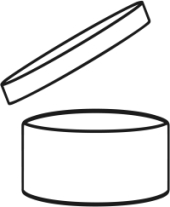
Where a corrective product has a minimum durability of thirty months or less, it must exist marked on the container and the packaging with a all-time-earlier date or the symbol shown below.

The indication must be in the course 'All-time used before the end of', followed by the date (day / month / year or calendar month / year) or an indication of where the appointment appears on the packaging. If any particular conditions must exist observed to guarantee the stated durability, these must as well be described.
Where a product has a shelf life of more than 30 months, information technology must instead be marked with the symbol shown below together with an indication (in months, or years and months) of the period later on opening for which the product can be used without harming the consumer.
Precautions
Precautions to be observed in use, as shown in the annexes to Regulation (EC) No 1223/2009, must be printed on the label. Special precautionary information on corrective products for professional person use, such as in hairdressing, must announced on the container and packaging.
Batch lawmaking
The batch number of manufacture or the reference for identifying the appurtenances.
Function
If not otherwise obvious from design and packaging.
Nominal quantity
Statement of the weight or volume of the product. At that place are exemptions for:
- free samples
- packs that contain less than five ml or v g
- sachets
Ingredients
The package in which the cosmetic product is supplied must deport a list of ingredients, headed 'Ingredients' (see note below), in descending social club of weight, determined at the fourth dimension the ingredient was added to the product.
All cosmetic products marketed in any function of the UK take to be labelled with a list of their ingredients, irrespective of the aqueduct of distribution. This requirement too applies to professional products, free samples, tester samples, multi-component products, products sold by post order or online, and products provided in hotels and other public facilities.
You exercise non need to include any of the following equally ingredients:
- impurities in the raw materials
- materials used in the training of, only not nowadays in, the final product
- materials used as solvents or carriers for perfumes and aromatic compositions
Perfume and aromatic compositions and their raw materials must be referred to as 'perfume' (come across note below) or 'aroma' unless a more specific indication of their presence is required in Annex 3 to Regulation (EC) No 1223/2009 (run into link in 'Key legislation' beneath).
Ingredients in concentrations of less than 1% may be listed in whatsoever lodge after those of 1% or more.
Colouring agents may be listed in any gild afterwards the other ingredients. For decorative cosmetics marketed in diverse colours, all colouring agents in the range may be listed, as long as the words 'may contain' or the symbol '+/-' is also used.
The ingredient name must be that listed in the International Nomenclature of Cosmetic Ingredients (INCI) or, if no such proper name is listed, one of the post-obit:
- chemic proper name
- European Pharmacopoeia name
- International Not-proprietary Name (INN), as recommended by the Globe Health Organisation
- European Inventory of Existing Commercial chemical Substances (EINECS), International Matrimony of Pure and Applied Chemistry (IUPAC), or Chemical Abstracts Service (CAS) identification reference
- color index number
A database of INCI names is available on the Europa website.
All ingredients present in the class of nanomaterials must be clearly indicated in the list of ingredients. The names of such ingredients must be followed by the word 'nano' in brackets.
There is a process detailed in Regulation (EC) No 1223/2009 that, subject to agreement, allows the confidentiality of some ingredients to exist maintained.
For consistency, the following conventions have been agreed by the Cosmetic, Toiletry and Perfumery Clan (CPTA), the United kingdom cosmetics manufacture merchandise association. Firstly, the word 'ingredients' should be given in capital letters, and secondly, the give-and-take 'perfume' should be replaced by 'parfum'. Although these conventions practice non have the force of police, their apply will be accustomed by UK enforcement authorities. If yous are exporting cosmetic products to countries in the European Economical Area (EEA), you should ostend that the authorities in those countries as well accept this convention.
Additional information
Boosted information must exist given where certain ingredients, such every bit preservatives and UV filters, are nowadays. This information is specified in Annexes 3, 4, V, and VI to Regulation (EC) No 1223/2009 (see link in 'Central legislation' beneath).
Presentation
All required information must be visible, enduring and easily legible. The ingredients list must be given in a language that is easily understood by the consumer. All of the other information must be in English language and can exist supplemented by other languages.
There is i gear up of rules about presentation for ingredients lists and another fix for the other information.
Ingredients list
The ingredients list must appear on the packaging or, if information technology is impossible to do and so or there is no packaging, on the container. If the production is sold loose, the ingredients list can exist given on the container in which the production is exposed for supply or on a notice. If this is not possible, the list can exist given on a leaflet, label, tag, tape or card enclosed with or attached to the product, along with an indication referring the consumer to it (either past mode of abbreviated information or the 'hand and book' symbol beneath). For small products such as soap and bathroom balls, a notice tin exist used instead of a leaflet, label, etc.

Other information
The other information must usually appear on both the container and the packaging. However, if information technology is non possible for the batch code to appear on the container, it can appear on the packaging simply. Similarly, where at that place are practical constraints, the atmospheric condition for use may appear on a leaflet, characterization, tag, tape or card enclosed with or fastened to the product, again with an indication referring the consumer to it.
For 'unpackaged' loose cosmetic products (such equally soap, bath balls and other modest products) information technology may be impossible for practical reasons for the ingredients list to be attached on a tag, tape or card. If that is the case, all the relevant information that would be required on the packaging, and as outlined higher up, must be given on a notice side by side to the container in which the cosmetic product is exposed for auction.
Back to meridian
Claims
Regulation (Eu) No 655/2013laying down common criteria for the justification of claims used in relation to cosmetic products states that claims should exist legal, truthful, supported past show, honest, fair, and clear and understandable to the end user.
In particular 'free from' claims should not exist used where they refer to an ingredient that is typically not used in that kind of cosmetic - for example, 'free from preservatives' in a perfume that already contains alcohol. Also complimentary-from claims should not be used where the ingredient is legal for use. This means claims such every bit 'complimentary from parabens' are not allowed.
For more than data on claims, please see the European Commission'due southTechnical Certificate on Cosmetic Claims.
Back to top
The requirements on the responsible person
The manufacturer of corrective products must comply with expert manufacturing practise. Compliance with good manufacturing do can be presumed where the industry is in accord with the relevant designated standards*.
[*'Designated standards' are those approved by the Secretary of Land and published by the British Standards Establishment (BSI).]
In order to demonstrate that a cosmetic product is safe, the UK responsible person must ensure that the cosmetic product has undergone a safety cess and that a cosmetic production safety report is produced. This condom assessment must be carried out by a person in possession of a diploma or other show of formal qualifications awarded on completion of a university course of theoretical and practical study in pharmacy, toxicology, medicine or a similar discipline.
Where a cosmetic product is supplied or manufactured in the United kingdom, the responsible person is required to proceed sure product information at the registered role accost or the address detailed on the product. This information must be easy for the nominated regime (mostly the responsible person's local trading standards service) to access and can exist requested in the case of medical emergency. The information must exist in English or some other language easily understood by the nominated authority.
The product information file (PIF) must include all of the following:
- the qualitative and quantitative limerick of the production. For perfume or perfume compositions in the product, you are only required to keep the proper name, lawmaking number and supplier identity. Qualitative data for all composites, and the quantitative information in relation to unsafe substances, must also be made easily available to the general public
- the physico-chemical and microbiological specifications of the raw materials and the finished product, and the purity and microbiological control criteria of the cosmetic product
- the method of industry, which must exist in accordance with good manufacturing do
- an assessment of safety for human health of the finished product, in the grade of a 'corrective product safety written report' (CPSR) signed by a qualified safety assessor, according to the criteria stipulated in Regulation (EC) No 1223/2009. In addition, a specific safe assessment is required for cosmetic products intended for use on children under the age of 3, and for cosmetic products intended exclusively for employ in external intimate hygiene
- the presentation of the cosmetic production must have into account the requirements of the Food Imitations (Safety) Regulations 1989, which concern dangerous imitations. See 'Food imitations' for more data on these Regulations
- existing data on the undesirable furnishings on human being wellness resulting from use of the product. This information must also be made easily available to the general public
- bear witness to justify any claims made by the production
- data on any animal testing performed by the manufacturer, their agents or suppliers, relating to the development or safety evaluation of the product or its ingredients
The PIF must be maintained in English at the UK address, and fabricated available to market surveillance and enforcement regime, which includes the Secretary of Land and local authority trading standards services in GB (also known as local weights and measures authorities).
Prior to placing the cosmetic product on the market the responsible person must submit the post-obit data to the UK Authorities through the UK's Submit Cosmetic Product Notifications service (SCPN):
- the category of cosmetic product and its proper noun or names, enabling its specific identification
- the proper name and address of the responsible person (if the PIF is made readily accessible)
- the contact details of a physical person to contact in the example of necessity (if the corrective product has been imported into the United kingdom)
- the presence of substances in the form of nanomaterials and their identification
- the frame formulation allowing for prompt and advisable medical treatment in the event of difficulties
When the cosmetic product is placed on the market, the responsible person must notify to the Uk Government the original labelling, and, where reasonably legible, a photograph of the corresponding packaging.
Responsible persons who consider or accept reason to believe that a cosmetic product that they accept placed on the market place is not in conformity with Regulation (EC) No 1223/2009 must immediately take the corrective measures necessary to bring that product into conformity, withdraw information technology or call up it, as appropriate. Where the cosmetic product presents a 'serious undesirable event' (SUE) or risk to human health, responsible persons and/or distributors must immediately inform their local trading standards service, giving details of the non-compliance and of the corrective measures to exist taken.
An importer (which must by definition exist based in the United kingdom) that places a product on the GB marketplace is the responsible person in respect of that product.
Back to elevation
Microbeads
Legislation prohibits the industry and sale of rinse-off personal care products containing plastic microbeads. For more than data see 'Microbeads'.
Dorsum to pinnacle
Farther information
The Office for Product Safety and Standards (OPSS) has published guidance on making corrective products available to consumers in Great Britain.
Dorsum to top
Trading standards
For more than information on the piece of work of trading standards services - and the possible consequences of not abiding by the law - please run across 'Trading standards: powers, enforcement and penalties'.
Back to top

How Old Do You Have To Be To Sell Makeup,
Source: https://www.businesscompanion.info/en/quick-guides/product-safety/cosmetic-products
Posted by: mejiatharls.blogspot.com
0 Response to "How Old Do You Have To Be To Sell Makeup"
Post a Comment